
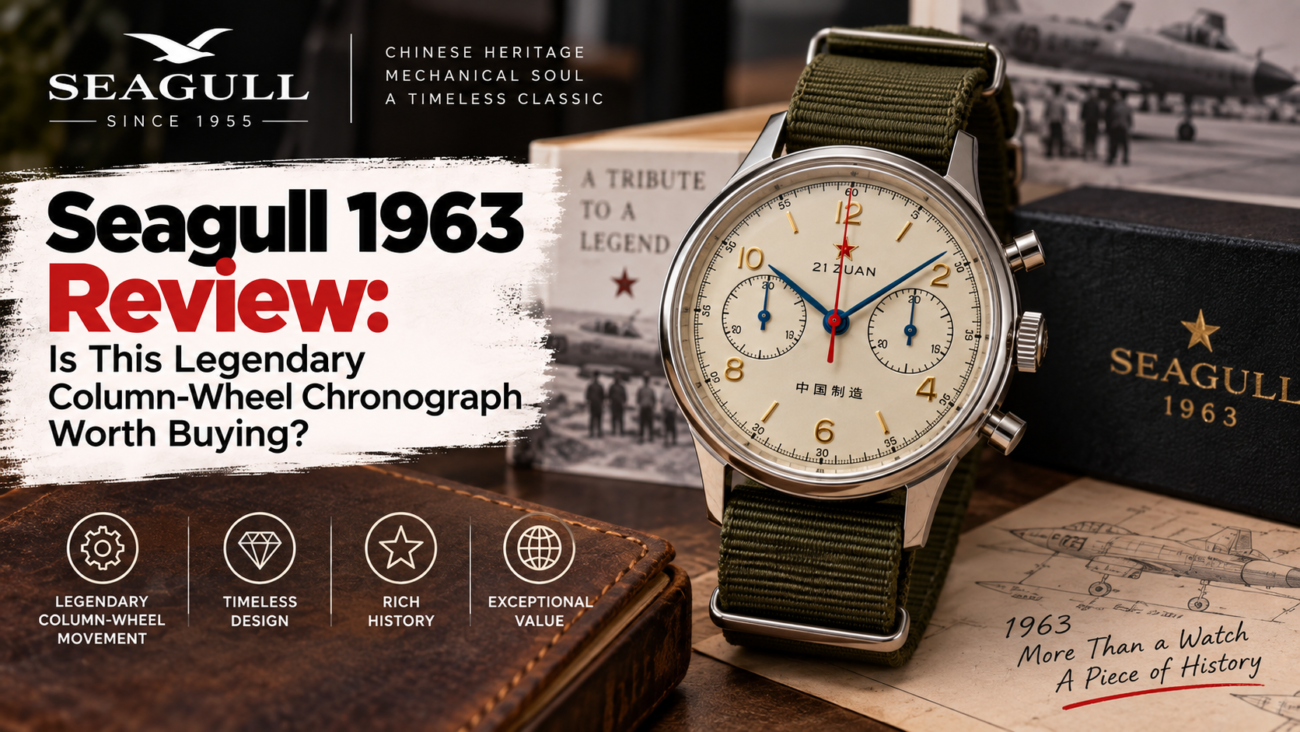
Seagull 1963 Review: Is This Legendary Column-Wheel Chronograph Worth Buying?
Finding an authentic mechanical chronograph priced under $1,000 often feels next to impossible—let alone finding one equipped with a traditional column-wheel movement. Yet, the Seagull 1963 reissue sits comfortably in the accessible horology space while carrying a legitimate military aviation heritage.
Originally commissioned in the early 1960s under the codename “Project 304” for Chinese Air Force pilots, the watch has grown into a widespread favorite among watch collectors. Available directly from specialist retailers like Seagull1963.com, this timepiece combines classic midcentury styling with a mechanical movement visible through an open back. This review covers its architecture, wearability, build quality, and key considerations to help you evaluate if it belongs on your wrist.
What Makes the Seagull 1963 Stand Out in Horology?
Most mechanical watches under $500 stick to simple three-hand automatic movements. Chronographs—watches equipped with built-in stopwatch functions—require significantly more complex mechanical gearing. Swiss-made column-wheel chronographs usually command premium prices running into thousands of dollars. The Seagull 1963 bypasses this barrier by utilizing the ST19 manual-wind movement, a direct descendant of the Swiss Venus 175 tooling acquired by China in the 1960s.
Beyond its mechanical credentials, the visual presentation offers genuine retro appeal. The cream-gold dial, applied gold markers, vibrant blue hands, sharp red chronograph hand, and iconic red star emblem create a colorful, vintage pilot aesthetic distinct from conventional sports watches.
Key Specifications & Meaningful Features
The collection spans various case diameters, glass options, and colorways tailored to different wrist sizes and user preferences.
ST19 Manual-Wind Movement
A hand-winding mechanical engine operating at 21,600 BPH with approximately 42 hours of power reserve. The traditional column-wheel mechanism provides tactile pusher action and a striking view through the exhibition caseback.
Multiple Case Dimensions
Available in a classic 38mm size (true to the 1963 original proportion) as well as 40mm and 42mm variations designed for larger wrists.
Acrylic or Sapphire Options
Buyers can choose between vintage-correct domed acrylic crystal for warm light distortion or scratch-resistant boxed sapphire crystal for everyday durability.
316L Stainless Steel Build
Constructed with brushed and polished 316L stainless steel, offering water resistance ratings ranging from 3 ATM to 5 ATM depending on the specific model edition.
Design & Packaging Highlights
- Historic Aviation Design: Faithfully recreates the aesthetics of the original pilot watches issued to Chinese aviators.
- Complete Presentation: Typically packaged in a protective metal storage tin and supplied with a military-style textile NATO strap.
- Exhibition Caseback: Offers a clear window into the intricate, mechanical column-wheel mechanism in motion.
On the Wrist: Wearability and Practical Details
When worn, the 38mm version stays true to midcentury military proportions. Featuring a lug-to-lug length of around 47mm, it rests comfortably on small to average wrists without overhang. Collectors seeking a stronger wrist presence often opt for the modern 40mm or 42mm variants.
The daily ritual of manual winding provides a hands-on connection to the mechanical watch. Pressing the top pusher delivers a firm, tactile click characteristic of column-wheel systems when engaging or resetting the central chronograph hand.
Things Buyers Should Consider Before Buying
To ensure this timepiece matches your lifestyle, keep these practical points in mind:
- Manual Winding Required: The ST19 movement is not automatic. It requires regular manual winding of the crown to stay powered.
- Splash-Only Water Resistance: Ratings of 3 ATM to 5 ATM make it suitable for rain and daily splashes, but not for swimming, showering, or diving.
- Lugs and Strap Widths: Sizing varies across models—the 38mm version has 18mm lugs, while 40mm and 42mm versions feature 20mm and 22mm lug widths respectively.
Who Is the Seagull 1963 Best For?
This watch fits several specific collector profiles:
- Mechanical Watch Enthusiasts: Anyone looking to own an accessible mechanical chronograph with visible, functional architecture.
- Retro & Military Design Fans: Buyers who appreciate vintage aviation dials, warm tones, and historic midcentury reissues.
- Casual & Seasoned Collectors: Watch lovers looking to add a unique, colorful piece to a collection dominated by standard black or silver dials.
Price & Overall Value
Official catalog prices for the Seagull 1963 line generally hover between €335 and €500, varying based on case size, crystal material (acrylic vs. boxed sapphire), and special variations like Bronze, Panda, or Moonphase models.
Considering that Swiss mechanical chronographs routinely start well above $1,500, acquiring a historical column-wheel chronograph in this price bracket makes it one of the most compelling mechanical values on the market.
Final Verdict: Is It Worth It?
The Seagull 1963 offers an exceptional blend of mechanical complexity, military heritage, and distinct vintage styling. While prospective buyers should respect its manual-wind nature and limited water exposure, the experience of owning a column-wheel chronograph with a clear display caseback makes it a solid investment for enthusiasts. For anyone building a mechanical watch collection, it remains a standout recommendation.
Explore the Official Seagull 1963 Range
Compare case dimensions, crystal options, and strap combinations directly on the boutique store.
